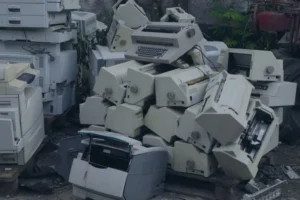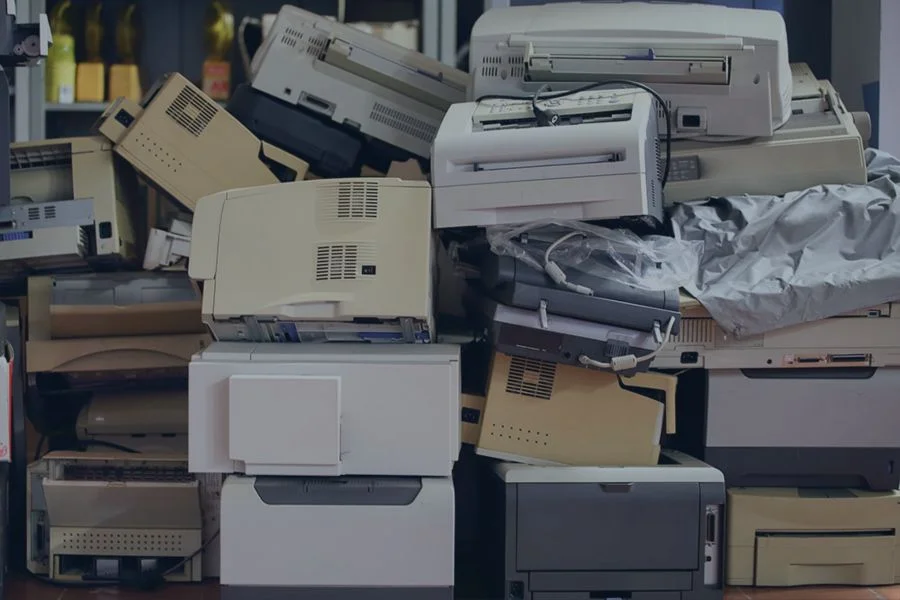
Printers are not obsolete, but the way people use them has changed. Digital documents, cloud storage, electronic signatures, remote work, and hybrid offices have reduced how much many people print. At the same time, millions of new printers continue to be sold, while older machines reach the end of their useful lives every year.
Around 100 million printers and scanners were sold worldwide in 2021, while more than 30 million printers and scanners become obsolete each year in the United States. With the average printer lasting approximately five years, new equipment is constantly replacing older machines and creating another source of electronic waste.
Replacing printers at your business or facility? EACR Inc. provides printer recycling services for organizations retiring printers, scanners, ink and toner cartridges, and other electronic equipment.
Printer Waste Statistics at a Glance
Here are some of the most important statistics surrounding printer waste:
- Around 100 million printers and scanners were sold worldwide in 2021 (Statista, 2026).
- The average printer lifespan is approximately five years.
- More than 30 million printers and scanners become obsolete annually in the United States (Market.Us, 2026).
- Only about 15% to 22% of printer and scanner e-waste is recycled globally (EACR Inc., 2026).
- Approximately 375 million printer cartridges are discarded annually in the United States.
- More than 1.1 billion cartridges are discarded globally each year (EcoToner USA, 2026).
- Only around 30% of printer cartridges are recycled or remanufactured.
- Printer and scanner waste can contain materials including lead, brominated flame retardants, and PCBs.
Together, these numbers show that printer waste is not limited to an occasional broken machine. It is an ongoing waste stream created by equipment replacement and the cartridges consumed throughout each printer’s lifespan.
Around 100 Million Printers and Scanners Are Sold Worldwide
Despite the shift toward digital work, printers and scanners continue to be purchased on a massive scale.
According to Statista, around 100 million printers and scanners were sold worldwide in 2021, showing that printing equipment remains a major product category even as workplaces become less dependent on paper.
Printers Are Still a Major Product Category
Printers remain common in homes, offices, schools, healthcare facilities, government agencies, warehouses, legal offices, and other organizations where physical documents are still part of everyday operations.
Printing habits may be changing, but demand has not disappeared. Businesses still need invoices, labels, contracts, reports, forms, educational materials, patient documents, and countless other printed materials.
Every New Printer Eventually Reaches End of Life
The waste problem becomes clearer when sales are viewed over time.
Every printer sold will eventually be repaired, replaced, retired, or discarded. When millions of new machines enter the market each year, millions of older machines are also moving closer to the end of their useful lives.
That creates a continuous cycle of new equipment entering service while older printers become part of the electronic waste stream.
The Average Printer Lasts About Five Years
The average lifespan of a printer is approximately five years, although some machines last much longer depending on their workload, maintenance, quality, and operating environment.
Printer Lifespans Create a Constant Replacement Cycle
A five-year average lifespan means printer replacement is happening continuously.
Equipment purchased several years ago is reaching the point where repair costs, maintenance problems, and performance issues begin pushing users toward replacement. At the same time, newer printers are entering service and beginning the same cycle.
For a deeper look at printer lifespan, common signs of failure, and when replacement may make sense, read our guide on how long printers last.
Printers Are Often Replaced Before They Completely Fail
A printer does not necessarily need to stop working entirely before it becomes outdated.
Organizations may replace equipment because repairs have become too expensive, newer software is no longer compatible, network requirements have changed, performance has declined, or the office is upgrading its technology.
As a result, printer waste includes both machines that have physically failed and machines that simply no longer meet the needs of the people using them.
More Than 30 Million Printers Become Obsolete Each Year
According to Market.Us, more than 30 million printers and scanners become obsolete each year in the United States.
That means tens of millions of machines can reach the end of their practical use within a single year, creating a substantial recurring stream of electronic waste.
This becomes especially noticeable when businesses, school systems, government agencies, hospitals, universities, and other large organizations replace equipment across an entire facility or network of locations.
Obsolete Does Not Always Mean Broken
A printer can still turn on and technically function while no longer being useful to its owner.
Printer waste can come from:
- Broken equipment
- Aging equipment
- Technology upgrades
- Office equipment replacements
- Changing printing needs
This distinction matters because printer waste is not driven entirely by equipment failure. Technology changes and changing workplace needs can also shorten the practical life of a machine.
Printers Are Not Obsolete, But Demand Is Changing
The growth of printer waste does not mean printers are disappearing.
Instead, the role of printing is changing.
Offices Are Printing Less
Digital workflows have reduced the need for many traditional paper processes. Documents that once filled filing cabinets can now be stored in the cloud, signatures can be collected electronically, and employees working remotely may rarely interact with a shared office printer.
According to STP Texas, roughly 20% decline in office print volumes compared with pre-pandemic levels.
Lower print volumes can mean fewer printers are needed in some offices, which may lead organizations to consolidate or replace existing printer fleets.
Printers Still Serve Important Uses
Lower demand does not mean printers have become irrelevant.
Laser printers, for example, continue to serve workplaces that require fast, consistent, higher-volume document printing. Schools, government offices, legal and financial organizations, and other businesses still depend on physical documents for many everyday processes.
The Market is Shifting, Not Disappearing
Inkjet printers have gained ground in smaller offices, home offices, and hybrid environments where printing volumes are lighter and color output may be more important.
Laser printers continue to play a role in environments where multiple people share a machine or large quantities of documents need to be printed consistently.
The important takeaway is that printer usage is changing rather than disappearing. Printers are still being manufactured, purchased, upgraded, replaced, and eventually discarded.
375 Million Printer Cartridges Are Discarded Every Year
The printer itself is only one part of the waste created by printing.
According to Ecotoner USA, an estimated 375 million ink and toner cartridges are discarded every year in the United States. Globally, more than 1.1 billion cartridges are discarded annually.
Cartridge Waste Adds Up Faster Than Printer Waste
A printer may remain in use for around five years, but it can consume many cartridges during that time.
Homes may replace cartridges several times throughout the life of a printer, while businesses, schools, and commercial environments with heavier print volumes may go through them much more frequently.
That creates a recurring waste stream long before the printer itself reaches end of life.
Most Cartridges Are Still Not Recycled
Only around 30% of printer cartridges are recycled or remanufactured, according to the estimate used for this guide.
That leaves roughly 70% being discarded, or approximately 262 million cartridges each year in the United States.
The same source estimates that discarded cartridges account for nearly 500 million pounds of waste annually in the U.S.
Those numbers make cartridge disposal an important part of the broader printer waste problem.
Printer Waste Includes More Than the Printer
The total waste created throughout the life of a printer can include:
- The printer itself
- Ink cartridges
- Toner cartridges
- Replacement consumables used throughout its lifespan
That is why printer recycling should consider more than just the machine.
EACR Inc. recycles printers as well as ink and toner cartridges, allowing organizations to include both equipment and consumables in the same recycling project.
Only 15% to 22% of Printer E-Waste is Recycled
Only about 15% to 22% of printer and scanner e-waste is recycled globally.
If that estimate is accurate, most retired printing equipment still does not make its way through recycling channels.
Most Retired Printer Equipment Misses Recycling Streams
Millions of printers and scanners become outdated every year, but recycling rates remain relatively low.
Some equipment may be stored for years after it stops being used. Other machines may be discarded with ordinary waste or otherwise fail to reach an electronics recycling program.
Increasing printer recycling means getting more of that retired equipment into systems designed to process electronics instead of allowing it to remain outside the recycling stream.
Printer Waste Can Contain Hazardous Materials
Discarded printers and scanners can contain materials including lead, brominated flame retardants, PCBs, and other electronic components and materials.
That is another reason these machines should be handled as electronic waste rather than treated like ordinary household or commercial trash.
For a broader look at what happens when electronics reach end of life, see our computer e-waste statistics.
Recycle Old Printers With EACR Inc.
Millions of printers continue entering the market while tens of millions become obsolete each year. Add hundreds of millions of discarded ink and toner cartridges, and printing continues to create a significant electronic waste stream even as workplaces become more digital.
EACR Inc. provides printer recycling services for businesses, schools, municipalities, healthcare facilities, government organizations, offices, and other facilities. Printers, scanners, ink cartridges, toner cartridges, and other electronics can all be included as part of a coordinated recycling project.