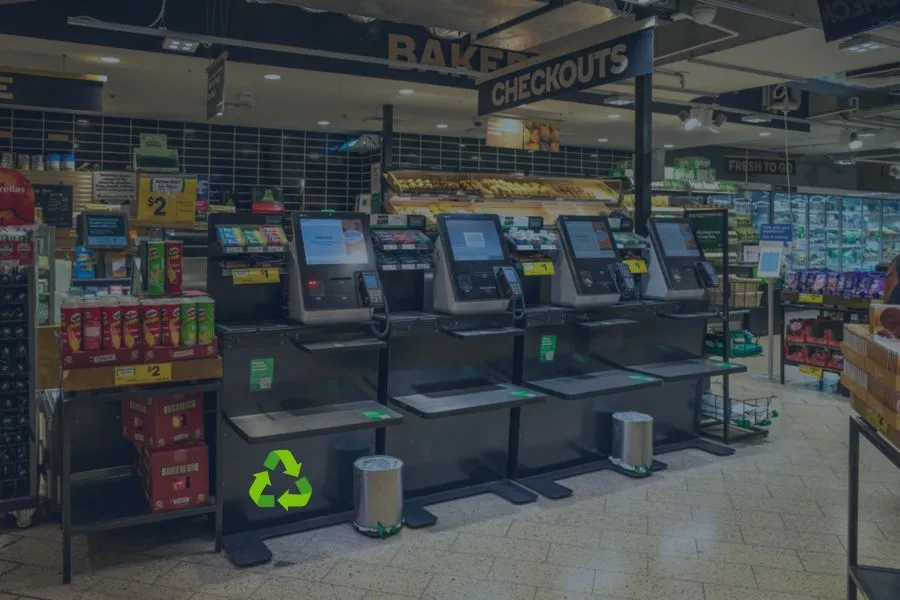
Self-checkout lane recycling means recycling the entire checkout system, not just pulling out the touchscreen or removing the cash drawer.
Grocery stores, pharmacies, convenience stores, big-box retailers, and other businesses regularly replace self-checkout equipment as hardware ages, payment systems change, or POS technology is upgraded. A single lane may include a touchscreen computer, POS hardware, barcode scanner, payment terminal, receipt printer, cash-handling equipment, internal storage, networking hardware, wiring, and a large steel or aluminum frame.
That combination makes self-checkout recycling more involved than getting rid of ordinary store fixtures. Retailers may retire systems during remodels, store closures, POS replacements, multi-location refreshes, hardware failures, or conversions to newer checkout formats. EACR is an electronics recycling company that can help retailers recycle outdated self-checkout lanes, kiosks, POS equipment, and other electronics.
Quick Answer: Can Self-Checkout Lanes Be Recycled?
Yes. Self-checkout lanes and retail kiosks contain electronic and metal components that can be separated through an electronics recycling program.
Common components include:
- Computers
- Touchscreen displays
- Barcode scanners
- Payment terminals
- Receipt printers
- Circuit boards
- Hard drives or solid-state storage
- Power supplies
- Copper wiring
- Steel and aluminum structures
The main thing to understand is this:
A self-checkout lane is not just retail furniture.
Even though the cabinet and frame may look like ordinary store fixtures, the system contains integrated computing, payment, communication, scanning, and sometimes cash-handling hardware.
What is Inside a Self-Checkout Lane?
Self-checkout systems combine several technologies into one checkout station. The exact configuration varies by manufacturer and retailer, but most units contain multiple types of electronic equipment.
Touchscreen Computer and POS Hardware
The main interface is typically built around a computer running checkout or POS software.
That hardware may include:
- Processor
- Memory
- Motherboard
- Internal storage
- Network hardware
- USB and peripheral connections
These components should be handled as electronic equipment when the system is retired.
Barcode Scanner and Scale
Many self-checkout lanes use an integrated scanner and scale.
Depending on the system, this may include:
- Laser barcode scanners
- Imaging scanners
- Produce scales
- Scanner-scale assemblies
- Weight sensors
These assemblies contain circuit boards, optical components, wiring, sensors, and metal parts.
Payment Terminal and Card Reader
Modern self-checkout systems commonly include dedicated payment hardware.
That may include:
- Credit and debit card readers
- PIN pads
- Contactless payment hardware
- NFC readers
- Chip card readers
Payment equipment deserves careful attention during retirement because it may contain system configurations or other information connected to the retailer’s payment environment.
Receipt Printer
Most checkout lanes include a thermal receipt printer.
Inside may be:
- Small motors
- Circuit boards
- Wiring
- Rollers and print mechanisms
- Plastic housing
- Metal components
These printers can usually be processed alongside other electronic equipment during a larger checkout-system recycling project.
Cash Handling Equipment
Some self-checkout systems also accept and dispense cash.
Depending on the configuration, that may involve:
- Bill acceptors
- Coin dispensers
- Cash recyclers
- Cash drawers
Not every modern self-checkout lane accepts cash, so the equipment inside can vary considerably from one system to another.
Internal Storage and Data-Bearing Devices
Self-checkout systems may also contain storage hardware.
That can include:
- Hard drives
- SSDs
- Embedded flash storage
- Computer memory
- Embedded computers
- Networked POS systems
Retailers should account for these devices before equipment leaves their control.
That does not mean every self-checkout lane necessarily stores customer card data locally. Depending on the system architecture, however, the hardware may contain operating-system files, configuration information, transaction-related records, logs, or other business data.
Metal Frame, Cabinet and Wiring
The physical structure of the checkout lane also contains recyclable materials.
These may include:
- Steel
- Aluminum
- Copper wiring
- Fasteners
- Brackets
- Internal mounting hardware
During processing, these materials can be separated from the computers, scanners, payment equipment, and other electronics.
Why Data Security Matters When Retiring Self-Checkout Equipment
Recycling self-checkout equipment is not only about recovering metals and electronics.
Some of the hardware inside a checkout lane may contain business or operational data, including:
- Local operating-system files
- POS software
- Device configurations
- Store network information
- Transaction-related records
- Employee or administrative credentials
- Logs or cached data
That makes data handling an important part of any retail equipment retirement project.
Identify Data-Bearing Devices
Before equipment is removed, retailers should determine which components contain storage.
That may include:
- POS computers
- Hard drives
- SSDs
- Embedded computers
- Certain kiosks
- System controllers
For multi-location projects, keeping an inventory of these devices can also help IT teams track equipment by store and asset number.
Follow the Organization’s Data-Destruction Policy
Retailers should handle stored information according to their existing IT, security, and data-retention procedures.
Depending on the equipment and internal policy, that may involve:
- Sanitizing storage devices
- Removing hard drives or SSDs
- Routing media for physical destruction
- Recording device or asset information before removal
For equipment that requires secure handling, EACR also provides data destruction services for hard drives, SSDs, and other data-bearing devices.
The goal is simple: identify anything that may contain data and make sure it follows the organization’s approved process before the equipment leaves its control.
How to Recycle Self-Checkout Lanes and Kiosks
Retiring one kiosk is fairly manageable. Replacing checkout systems across an entire store or retail chain takes more planning.
A structured process helps keep equipment, data, and logistics under control.
1. Inventory the Equipment
Start by identifying what is actually being removed.
Record:
- Number of self-checkout lanes
- Store locations
- Manufacturer and model
- Major integrated components
- Whether the systems accept cash
- Known data-bearing devices
For larger retailers, organize the inventory by store or facility location.
That makes pickup scheduling, asset tracking, and data handling much easier.
2. Remove Cash and Store Materials
Before the equipment leaves the store, remove anything that does not belong with the recycling load.
That includes:
- Bills and coins
- Receipt paper
- Store keys
- Merchandise
- Internal documents
- Proprietary materials
- Loose supplies
It sounds obvious, but this is an easy step to miss during a fast remodel or store closure.
3. Address Stored Data
Coordinate with the organization’s IT team before recycling any computer or storage equipment.
The process may include:
- Identifying hard drives and SSDs
- Removing or sanitizing storage where appropriate
- Documenting asset information
- Following existing data-destruction procedures
Retail staff should not randomly dismantle POS hardware just to look for storage devices. Data handling should follow an organized internal process.
4. Disconnect the Equipment Safely
Before removal, self-checkout equipment should be properly shut down and disconnected.
That may involve:
- Powering systems off
- Disconnecting electrical service
- Removing network connections
- Detaching peripheral equipment
- Separating the lane from surrounding fixtures
Larger systems may be heavy, bulky, or anchored in place, so coordinated removal may be necessary.
5. Choose the Right Recycling Method
The right recycling option depends heavily on quantity.
Possible approaches include:
- Scheduled electronics pickup
- Store equipment cleanout
- Multi-location recycling program
- E-waste containers for smaller related electronics
- Equipment removal coordinated with renovations or store closures
For one kiosk, a smaller pickup may be enough.
For a retailer replacing dozens or hundreds of self-checkout systems, coordinated collection across multiple stores is usually much more practical.
6. Keep Recycling and Removal Records
Businesses may also want records showing what equipment was removed and when.
Useful information may include:
- Store location
- Equipment quantities
- Pickup date
- Certificates of recycling
- Data-bearing equipment
- Recycling documentation
These records can help support internal asset management, IT tracking, and facility documentation after the project is complete.
What Happens to a Self-Checkout Lane After Recycling?
Once a retired self-checkout system reaches a recycling facility, it can be separated into its major electronic and material components.
Intake and Equipment Sorting
The equipment is received and categorized based on the type of system and the components it contains.
A full lane may be handled differently from smaller standalone kiosks or individual POS devices.
Data-Bearing Equipment Separation
Computers, hard drives, SSDs, and other storage devices are identified and routed according to the required data-handling process.
This step helps keep data-bearing equipment separate from general material processing.
Dismantling
The integrated system can then be broken down into major categories, including:
- Computers
- Displays
- Scanners
- Payment hardware
- Printers
- Wiring
- Metals
- Plastics
Breaking the system apart allows each material or device type to follow a more appropriate recycling route.
Electronics Processing
Circuit boards, power supplies, sensors, controllers, and other electronic assemblies are separated and routed into appropriate downstream electronics recycling streams.
Metal Recovery
Self-checkout systems may contain substantial amounts of metal.
Steel, aluminum, copper, and other metals can be recovered from:
- Frames
- Cabinets
- Wiring
- Motors
- Brackets
- Internal mounting hardware
Plastic Separation
Plastic housings, bezels, panels, and other plastic components are sorted based on material type and available processing options.
Not every plastic component follows the same recycling path, which is why material separation matters.
Frequently Asked Questions About Self-Checkout Recycling
Can Self-Checkout Lanes Be Recycled?
Yes.
Self-checkout lanes contain computers, scanners, payment equipment, printers, wiring, metals, plastics, and other components that can be separated through an electronics recycling program.
Are Self-Checkout Machines Considered E-Waste?
The electronic components inside self-checkout systems are electronic equipment and can be handled through appropriate electronics recycling programs.
The larger frame and cabinet may also contain recyclable metal and plastic components.
Do Self-Checkout Machines Store Data?
They can.
Depending on the system design, checkout equipment may contain operating-system files, POS configurations, logs, transaction-related information, network settings, or other business data.
The exact information stored depends on how the retailer’s system is configured.
Should Hard Drives Be Removed Before Recycling?
That depends on the retailer’s IT and data-destruction procedures.
Data-bearing devices should be identified and handled according to the organization’s internal requirements before the equipment is recycled.
Can Credit Card Terminals Be Recycled With Self-Checkout Equipment?
Yes, when accepted by the recycling provider.
Credit card terminals and payment devices are electronic equipment and can often be included as part of a larger retail electronics recycling project.
Can an Entire Retail Chain Recycle Self-Checkout Lanes at Once?
Yes.
Multi-location recycling programs can coordinate equipment removal and recycling across numerous stores rather than treating every location as an unrelated project.
This is especially useful during chain-wide technology refreshes, remodels, or POS platform changes.
What Other Retail Equipment Can Be Recycled at the Same Time?
A larger retail electronics project may include:
- Cash registers
- POS terminals
- Barcode scanners
- Receipt printers
- Payment terminals
- Computers
- Servers
- Network equipment
- Customer displays
- Handheld scanners
- UPS systems
Conclusion — Recycling Retired Self-Checkout Equipment
A self-checkout lane is a complex electronic system, not simply a piece of retail furniture. A single unit may contain computers, storage devices, payment hardware, scanners, printers, wiring, networking equipment, and substantial steel or aluminum assemblies.
Before retiring these systems, retailers should inventory the equipment, identify data-bearing devices, disconnect the hardware properly, and choose a recycling and logistics plan that fits the size of the project. If your business is replacing self-checkout lanes, kiosks, POS systems, or other retail technology, EACR is an electronics recycling company that can help coordinate equipment recycling, scheduled pickups, multi-location projects, and appropriate documentation.