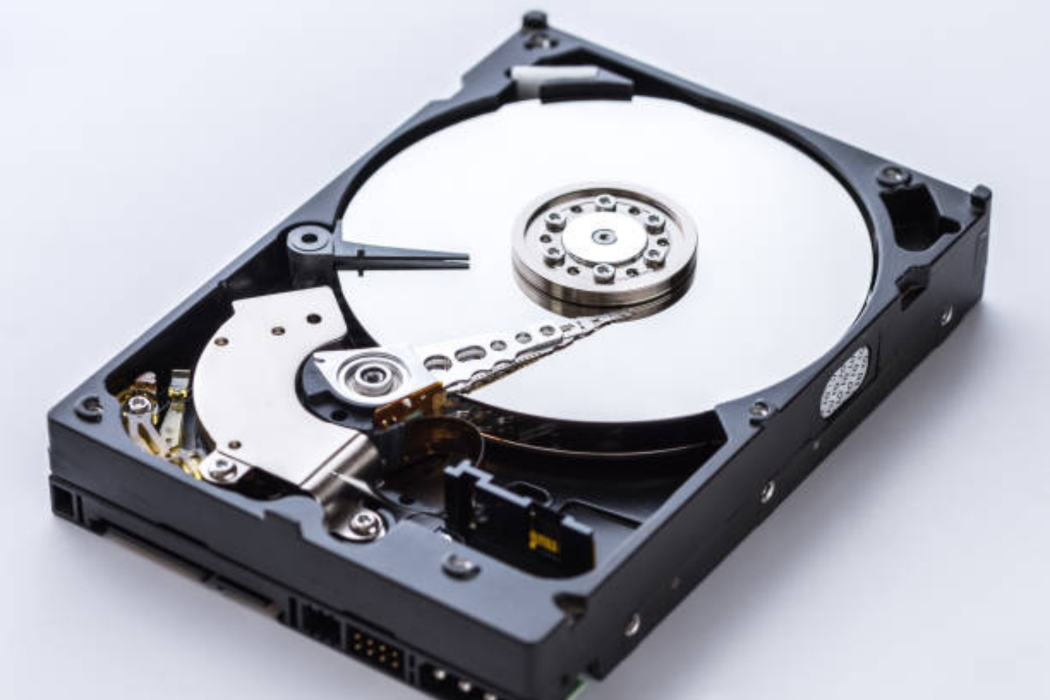
What is a hard drive made of? A traditional hard drive is made of aluminum or glass platters, magnetic coatings, carbon protective layers, copper wiring, rare earth magnets, silicon chips, and a printed circuit board (PCB).
That applies mainly to HDDs (hard disk drives) — the mechanical drives with spinning disks and magnetic storage. SSDs (solid-state drives) are different. They contain silicon-based flash memory and semiconductor components instead of moving parts and magnetic platters.
Understanding the materials inside a hard drive matters. It explains why some drives fail after a drop, why others survive heat or water exposure, and why data recovery requires cleanroom precision.
Quick Answer: The Main Materials Inside a Hard Drive
Here’s the simple breakdown:
- Aluminum or glass platters – The rigid disks that hold stored data
- Magnetic ferromagnetic coating – The thin layer that stores 1s and 0s
- Carbon protective layer – Protects the magnetic surface
- Copper wiring – Powers motors and carries electrical signals
- Rare earth magnets (neodymium) – Move the actuator arm
- Steel spindle – Spins the platters at high speed
- Fiberglass circuit board (PCB) – Controls power and communication
- Silicon chips – Manage firmware and data processing
That’s the physical foundation of most traditional hard drives.
Materials Inside a Traditional HDD (Hard Disk Drive)
Platters and Magnetic Storage Layers
At the center of an HDD are platters — flat circular disks that spin thousands of times per minute.
These platters are made from:
- Aluminum alloy
- Tempered glass
- Or ceramic composites
The base material is non-magnetic. On top of it sits a thin ferromagnetic film, typically only 10–20 nanometers thick. That layer stores data through microscopic magnetic polarity changes.
Why does nanometer thickness matter? Because at that scale:
- Data density increases dramatically
- Any physical damage becomes catastrophic
- Even microscopic contamination can destroy stored information
The entire storage system relies on extreme material precision.
The Motor and Mechanical System
An HDD is a mechanical device. That means materials must handle motion and vibration.
Key components include:
- Steel spindle – Holds and stabilizes the platters
- Copper windings – Inside the motor that spins the disks
- Precision bearings – Reduce friction and maintain balance
- Rare earth actuator magnets (neodymium) – Move the read/write arm
The motor must spin smoothly at 5,400 to 7,200 RPM (or higher in enterprise drives). Any imbalance can cause read errors or internal damage.
Read/Write Heads
The read/write heads are microscopic composite microelectronic components.
They:
- Convert magnetic signals into electrical data
- Write data by changing magnetic polarity
- Float just 3–6 nanometers above the platter surface
That tiny gap is called the flying height. For perspective, there are one million nanometers in a millimeter.
Because the tolerance is so tight, contamination is catastrophic. A single dust particle can cause a head crash and permanently damage the magnetic layer.
What is an SSD Made Of?
Unlike HDDs, SSDs have no spinning disks, no motors, and no magnets.
They are entirely electronic.
NAND Flash Memory (Silicon-Based)
SSDs store data using NAND flash memory, built from silicon wafers.
These chips:
- Use semiconductor architecture
- Store data as electrical charge
- Contain no magnetic storage layers
Instead of magnetizing a surface, SSDs trap electrons inside microscopic memory cells.
SSD Controller and PCB
An SSD also contains:
- A silicon controller chip that manages data flow
- Copper traces on a fiberglass PCB
- Gold-plated connectors for reliable signal transfer
There are no moving parts. Everything happens electronically.
That’s why SSDs are:
- Faster
- More shock-resistant
- Quieter
- Less vulnerable to mechanical failure
HDD vs SSD Materials Comparison
Here’s a quick materials comparison:
| Component | HDD | SSD |
| Moving Parts | Yes | No |
| Magnetic Storage | Yes | No |
| Flash Memory | No | Yes |
| Rare Earth Magnets | Yes | No |
| Spindle Motor | Yes | No |
| Shock Resistance | Moderate | High |
Takeaway: HDDs rely on magnetic materials and precision mechanics. SSDs rely on semiconductor silicon and electronics. Different materials lead to different strengths, weaknesses, and failure patterns.
Rare Materials Inside Hard Drives
Hard drives aren’t just aluminum and plastic. They contain reusable materials — which is why proper recycling matters.
Rare Earth Magnets (Neodymium)
Traditional HDDs use neodymium magnets in the actuator system. These are extremely strong rare earth magnets that move the read/write arm with precision.
Environmental impact:
Rare earth mining is energy-intensive and can produce significant waste if not managed properly. Recovering neodymium from end-of-life electronics reduces the need for new extraction.
Supply chain considerations:
Rare earth elements are geographically concentrated in production. That makes recovery and reuse increasingly important for long-term supply stability.
Precious Metals (Gold, Palladium)
Hard drive circuit boards contain small amounts of:
- Gold (connector contacts and trace plating)
- Palladium (in certain electronic components)
These metals are used because they:
- Resist corrosion
- Conduct electricity efficiently
- Maintain signal reliability over time
Copper and Aluminum
Hard drives contain significant amounts of:
- Copper (motor windings, PCB traces, wiring)
- Aluminum (outer casing, internal structural components)
Energy savings from recycling:
Recycling aluminum uses up to 95% less energy than producing new aluminum from raw ore. Copper recycling also dramatically reduces energy use compared to primary mining.
Can Hard Drive Materials Be Recycled?
Yes — and they should be.
Aluminum Recovery
Drive casings and internal structural parts are separated and processed for aluminum recovery. The material can be melted and reused without degrading quality.
Copper Recovery
Copper from motor windings and circuit boards is extracted and refined for reuse in new electronics and wiring systems.
Circuit Board Processing
PCBs go through specialized recycling processes to recover:
- Gold
- Silver
- Palladium
- Copper
These materials are separated using mechanical and chemical processing systems designed for electronics.
Magnet Removal
Rare earth magnets can be removed and reused or processed for material recovery, reducing reliance on new mining operations.
Data Destruction Methods
Before recycling, data must be securely destroyed. Common methods include:
- Physical shredding – Crushing or fragmenting the drive
- Degaussing – Demagnetizing HDD platters
- Destruction processes – With documentation for compliance
Environmental responsibility and data security go hand in hand.
If you’re retiring storage devices, make sure both are handled properly.
Frequently Asked Questions on Hard Drive Anatomy
Are hard drives made of glass?
Some are. Many HDD platters are aluminum, but higher-performance drives often use glass or ceramic substrates for added rigidity and stability.
Do hard drives contain gold?
Yes. Small amounts of gold are used on circuit boards and connectors because gold resists corrosion and ensures reliable electrical contact.
What rare earth metals are inside a hard drive?
Neodymium is the primary rare earth element used in traditional HDDs, mainly in the actuator magnets.
Is it safe to open a hard drive?
No. Opening a hard drive outside of a controlled clean environment can introduce dust and cause permanent platter damage.
Can hard drive materials be melted down?
Yes. Aluminum, copper, and certain magnetic materials can be melted or processed for reuse. Circuit boards require specialized recycling systems.
Conclusion
Hard drives are built from precision materials — aluminum or glass platters, magnetic coatings, carbon layers, copper wiring, rare earth magnets, silicon chips, and fiberglass circuit boards.
Traditional HDDs rely on magnetism and mechanical systems. SSDs rely on silicon-based flash memory and electronics. Different materials lead to different performance profiles and failure patterns.
At the end of life, these devices carry both environmental value and security risk. The metals are recoverable — but the data must be destroyed.
If you’re upgrading or decommissioning storage devices, take the next step: recycle responsibly and ensure secure data destruction through professionals.