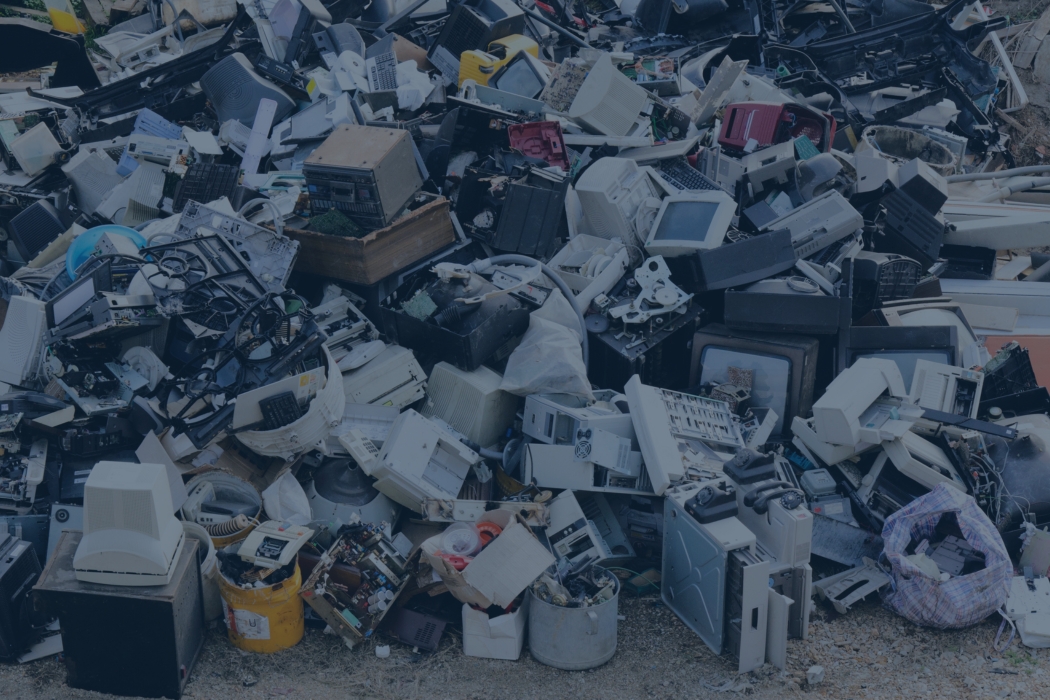
The United States generates close to 7 million tons of electronic waste every year. That’s old laptops, dead phones, broken TVs, and retired servers — stacking up faster than we’re dealing with them. And most of it doesn’t get recycled.
That’s not just an environmental problem. It’s a data security problem. It’s a public health problem. And it’s a massive waste of reusable materials that could be recovered and put back to work.
Every stat in this post is U.S.-focused or directly tied to what’s happening here at home. Where global numbers add context, we’ll use them — but the goal is to show you exactly where America stands on e-waste, and why it matters. If you’re a business, school, or government agency ready to do something about it, EACR Inc. provides licensed electronics recycling services nationwide — but first, let’s look at the numbers.
How Much E-Waste Does the U.S. Generate?
The short answer: a lot. The longer answer is genuinely staggering.
The U.S. is the Second Largest E-Waste Producer in the World
Only China generates more electronic waste than the United States. That’s not a comfortable position to be in. The U.S. produces approximately 6.9 million tons of e-waste per year, and that number keeps climbing. (PIRG.org, 2024)
To put it in perspective — that’s more than 13 billion pounds of discarded electronics every single year, from a single country.
Americans Own a Lot of Electronics
The average U.S. household owns 21 electronic devices. (Back Market, 2025) Phones, tablets, laptops, smart TVs, gaming consoles, smartwatches — it adds up fast. And every one of those devices has an end-of-life moment coming.
Phones Alone Are a Massive Problem
Americans threw away 151 million cell phones in a single year — roughly 416,000 phones per day. (Earth911, 2025) Most of those phones contained reusable materials that were never recovered, and some contained toxic substances that ended up exactly where they shouldn’t.
How Much of the U.S. E-Waste Actually Gets Recycled?
Less than you’d think — and probably less than most Americans assume.
The Recycling Rate Is Far Lower Than It Should Be
Only 15% of e-waste in North America was formally collected and recycled as of 2019. (Statista, 2024) That means 85% of our electronic waste is going somewhere other than a licensed recycling facility.
What People Say vs. What Actually Happens
48% of Americans say they recycle their old tech. (Back Market, 2025) But the formal recycling data doesn’t back that up. The gap between perception and reality is significant — and it suggests a lot of people believe dropping a device in a random bin or handing it off informally counts as recycling. It often doesn’t.
There’s No Shortage of Facilities
The U.S. has more than 2,000 companies that treat e-waste. (Science Direct, 2024) Access isn’t really the issue. Awareness, convenience, and habit are.
The Global Picture Isn’t Much Better
Worldwide, only 22.3% of e-waste was formally recycled in 2022 — and that number is expected to fall to 20% by 2030 as e-waste generation continues to outpace recycling efforts. (Global E-waste Monitor, 2024) The U.S. isn’t alone in falling behind, but that doesn’t make it any less urgent.
What Happens to E-Waste That Isn’t Recycled?
It doesn’t just disappear. It ends up somewhere — and where it ends up is a serious problem.
It’s Poisoning Our Landfills
Discarded electronics account for an estimated 70% of the heavy metals found in U.S. landfills. (EPA, 2024) Seventy percent. From a category of waste that makes up a fraction of total landfill volume. That imbalance tells you everything about how toxic this material really is.
What’s Actually Inside Your Old Devices
E-waste contains lead, mercury, cadmium, and brominated flame retardants — among other hazardous substances. These aren’t just unpleasant. They’re genuinely dangerous to human health and the surrounding environment when handled improperly.
These Chemicals Don’t Go Away
Unlike organic waste, the toxic materials in electronics don’t break down. They leach into soil and groundwater indefinitely, creating long-term contamination that extends well beyond the landfill itself. Communities near improper disposal sites bear the brunt of that exposure.
Americans Are Feeling It
72% of Americans report eco-anxiety about climate change and environmental challenges. (Back Market, 2025) People are paying attention. The question is whether awareness translates into action — and right now, the recycling numbers suggest it often doesn’t.
The Hidden Value Inside E-Waste
Most people think of old electronics as junk. They’re not. They’re full of reusable materials that have real worth — and right now, most of it is being buried or burned instead of recovered.
One Million Phones Is Worth More Than You Think
Recycling just one million cell phones recovers 772 lbs of silver, 35,000 lbs of copper, 75 lbs of gold, and 33 lbs of palladium. (The Round Up, 2026) Those aren’t trace amounts. That’s meaningful material that can be refined and reused in the production of new electronics, reducing the need to mine it from the ground. At EACR Inc., we make sure none of that goes to waste. Our cell phone recycling service ensures every device is processed responsibly, with full documentation and zero landfill.
E-Waste is a Dense Source of Reusable Materials
A single electronic device can contain up to 60 different types of heavy metals and elements. (Science Direct, 2024) Gold, silver, copper, aluminum, cobalt — it’s all in there. The problem is that recovering it requires a licensed facility with the right process. Tossing a device in a generic bin doesn’t get you there.
The Numbers at Scale Are Hard to Ignore
Globally, the raw materials sitting inside unrecycled e-waste were valued at $91 billion in 2022. Only $19 billion of that was actually recovered. That’s $72 billion worth of reusable material that was essentially thrown away in a single year.
The U.S. E-Waste Industry is Growing Fast
The U.S. e-waste management market was valued at $26.5 billion in 2025 and is projected to reach $45.3 billion by 2032. The industry is expanding because the need is undeniable — and businesses that get ahead of it now are better positioned for the compliance landscape that’s coming.
Where Does the U.S. Stand on E-Waste Legislation?
The rules vary a lot depending on where you are — and in many states, there aren’t many rules at all.
Half the Country Still Has No E-Waste Law
25 U.S. states have no legislation requiring e-waste to be recycled. That list includes Florida, Georgia, Massachusetts, and Colorado. If you’re operating in one of those states, there’s no legal floor — which means the responsibility falls entirely on individuals and organizations to do the right thing voluntarily. Not sure where your state stands? Check out our state e-waste law data to see exactly what’s required where you operate.
Lithium-Ion Batteries Are a Different Story
Federally, lithium-ion batteries are classified as hazardous waste. That means they cannot legally be thrown in the trash — full stop. This applies to the batteries in your phones, laptops, tablets, and anything else powered by lithium-ion cells.
Some States Are Leading the Way
Illinois and Vermont have battery stewardship programs that require retailers to provide collection drop-off points for batteries, including lithium-ion. Colorado and Oregon have gone a step further, requiring manufacturers to disclose the end-of-life pathway for every electronic device they sell in-state — or lose the right to sell there. These are meaningful steps, and more states are expected to follow.
Globally, Legislation Exists — Enforcement Is the Problem
81 countries had some form of e-waste legislation as of 2023, up from 78 in 2019. But having a law on the books and actually enforcing it are two different things. The gap between policy and practice is where most of the damage happens.
What Americans Can Do About E-Waste
Knowing the stats is step one. Doing something about it is step two.
Use a Licensed Electronics Recycler
Not all recycling is equal. A random bin at a big-box store is better than the trash, but it’s not the same as working with a licensed electronics recycler that documents the process, handles materials responsibly, and keeps your data protected. If you’re a business, school, or government agency, the bar is higher — and the consequences of cutting corners are real.
For organizations managing large volumes of end-of-life equipment, working with a professional electronics recycling company is the only way to ensure full compliance and accountability.
Data Destruction is Not Optional
A factory reset doesn’t wipe a hard drive. Data can still be recovered from a device that’s been reset, reformatted, or even physically damaged. For any organization handling sensitive information — financial records, medical data, employee files, government documents — data destruction needs to be a mandatory step before any device leaves your facility.
More Than Just Computers
Electronics recycling covers a wider range of items than most people realize. Computers, phones, and tablets are obvious. But batteries, appliances, solar panels, servers, and monitors all fall under e-waste too. Battery recycling alone is increasingly regulated, and improper disposal carries real legal risk. If you’re not sure whether something qualifies, a licensed recycler can tell you quickly.
Ready to Recycle the Right Way?
EACR Inc. provides licensed, large-scale electronics recycling for businesses, schools, municipalities, and government agencies nationwide. From single pickups to full data center decommissioning, we handle every step — with documentation to prove it.
Get a quote and let’s make sure your electronics don’t end up where they shouldn’t.