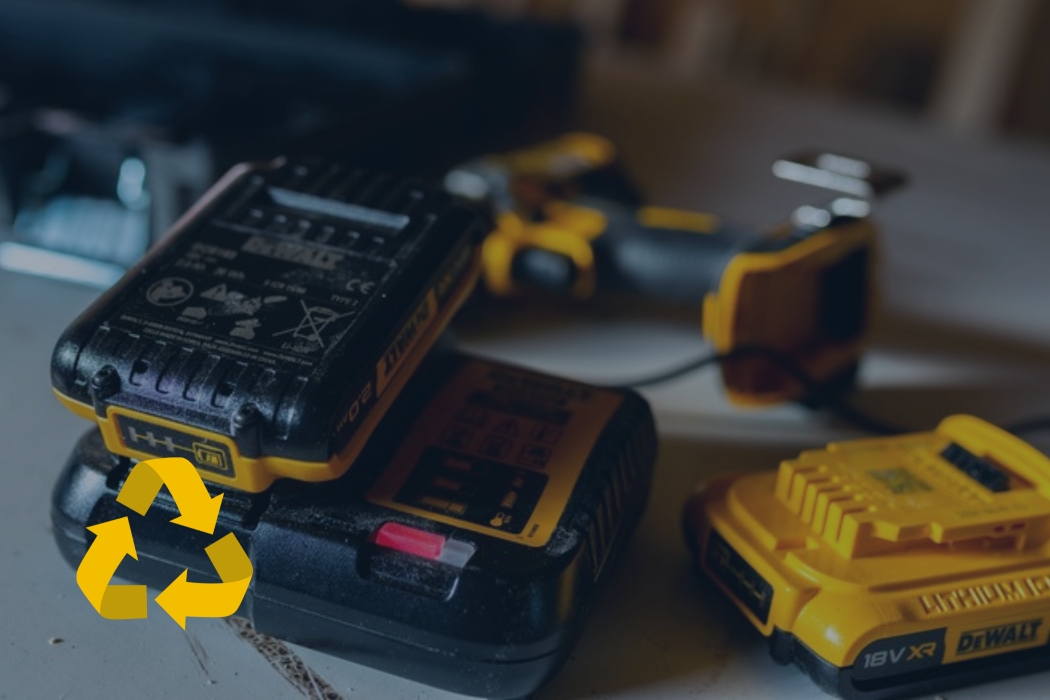
DEWALT battery recycling starts with one simple reality: these batteries are everywhere on jobsites, in garages, and in maintenance departments, which means dead packs can pile up faster than most people expect. Cordless DEWALT tools are extremely common, and old battery packs are easy to keep around “for later” until that later turns into a shelf or box full of dead batteries.
This adds up quickly across homeowners, contractors, and facilities teams. A few worn out packs turn into dozens before anyone deals with them, especially when batteries are spread across trucks, job boxes, and storage areas. If you’re dealing with DEWALT battery recycling as part of a cleanup, jobsite turnover, or business battery program, EACR Inc. can help with practical battery recycling services including drop-off, containers, and pickup support.
Typical DEWALT Items That Use Rechargeable Batteries
Common cordless power tools
DEWALT batteries show up across a huge range of everyday power tools. That includes drills and impact drivers, reciprocating saws and circular saws, grinders and oscillating tools, and even things like nailers and routers.
That matters because battery turnover is rarely tied to just one tool. Once one platform gets used across a full tool lineup, old packs start collecting in more places than people expect.
Yard and outdoor equipment
DEWALT battery use also extends well beyond the workshop. Leaf blowers, string trimmers, hedge trimmers, chainsaws, and even lawn mowers in battery platforms all contribute to the same battery stream.
So the recycling need is not limited to contractors or indoor tool storage. It also shows up in outdoor equipment, landscaping setups, and seasonal maintenance work.
Jobsite and maintenance equipment
There is also a growing list of DEWALT battery powered jobsite and maintenance equipment. Work lights, vacuums, radios and speakers, fans, inflators, and sprayers all add to the mix.
That means a business may not just be managing tool batteries. It may be managing batteries tied to jobsite support equipment, maintenance gear, and mobile work setups too.
Why this matters for recycling
This matters because one battery platform often supports a long list of tools and equipment. Dead batteries do not just pile up in one place. They build up across trucks, departments, job boxes, maintenance rooms, and storage shelves.
The recycling need usually starts with tools, but it becomes a battery management problem fast once enough packs start failing or aging out at the same time.
Common DEWALT Battery Types
Modern lithium ion battery packs
Most current DEWALT cordless systems use lithium ion batteries. That is the standard now because lithium ion packs are lighter, offer higher power output, provide longer runtime, and support cordless convenience across a wide range of tools.
The most common DEWALT platform families include 12V, 20V MAX, and FLEXVOLT. Those batteries may vary in size and capacity, but they are all part of the reason battery recycling has become a more regular issue for both homeowners and businesses.
Older DEWALT battery chemistries
Older DEWALT tools may still use Nickel Cadmium, or NiCd, batteries. In some cases, you may also run into older Nickel Metal Hydride references, though lithium ion and NiCd are usually the bigger conversation in DEWALT battery recycling.
That matters because older battery types are still out there, especially in backup tools, rarely used kits, or equipment that has been sitting around for years.
Why battery type matters
Battery chemistry matters because it affects safe handling, storage, prep, and recycling routing. It also helps avoid the common mistake of mixing older and newer battery packs together without any idea what is actually in the load.
The more clearly the battery type is identified upfront, the easier it is to handle the recycling process safely and cleanly.
Why DEWALT Battery Recycling Matters
These batteries should not go in the trash
Rechargeable batteries need proper recycling. They are not ordinary waste, and damaged or worn out packs should not be treated like everyday trash just because they are small enough to fit in a drawer or toolbox.
That is especially true once batteries start aging, swelling, or showing visible wear.
Jobsite batteries add up quickly
A single truck may only have a few bad packs at a time, which makes the issue easy to ignore. But a contractor, warehouse, maintenance department, or facilities team may have dozens before anyone stops to deal with them properly.
That is why DEWALT battery disposal tends to go from minor inconvenience to real cleanup project faster than people think.
Damaged packs need more attention
Some batteries need more attention than others. Swollen packs, cracked housings, overheated units, or anything visibly compromised should not be handled casually.
Once a battery looks damaged, it needs to be treated more carefully instead of getting tossed into a mixed pile and forgotten.
Better battery management helps operations
A more structured battery recycling process helps operations in ways that are easy to underestimate. It leads to cleaner storage areas, fewer random battery piles, and easier tool turnover and maintenance planning.
For businesses especially, better battery management is not just about getting rid of old packs. It is about keeping the whole operation cleaner and easier to manage.
DEWALT Battery Recycling Options
Option 1: Brand or retailer take-back
Brand or retailer take-back programs can work well when you are dealing with a single battery, an occasional replacement, or a situation where you are already using a participating return channel.
The main benefit is convenience when the program is available. The downside is that it is not always a great fit for volume, and the rules, eligibility, and overall convenience can vary depending on the brand or retailer.
Option 2: Drop-off recycling
Drop-off recycling is usually best for homeowners, a few loose batteries, or smaller contractors that do not have enough volume to justify a bigger collection setup.
The key is to confirm acceptance before going, protect the batteries during transport, and separate damaged packs if needed. For smaller projects, this is often the easiest path.
Option 3: E-waste collection containers
E-waste collection containers are a strong option for offices, maintenance teams, property managers, and businesses with recurring battery disposal. They work especially well when old packs build up gradually instead of all at once.
The big advantage is consistency. A container creates a central collection point, supports a cleaner storage process, and makes ongoing battery management easier instead of letting dead packs pile up in random places.
Option 4: Scheduled pickup through EACR Inc.
Scheduled pickup is usually the better option for contractors, facilities, warehouses, construction companies, and businesses dealing with recurring or high volume battery disposal.
It works better for large quantities, requires no hauling on your end, makes logistics easier, and supports more controlled handling throughout the process. For recurring operational cleanup, pickup is often the most practical route.
What the EACR Inc. Battery Recycling Process Looks Like
Step 1: Identify the battery load
The first step is figuring out what the project actually looks like. That means identifying which types of DEWALT packs are involved, how many batteries are in the load, and whether any damaged batteries are present.
This helps make sure the next step is based on the real scope of the project instead of guesswork.
Step 2: Choose the right collection path
Once the load is understood, the next step is choosing the right collection route. Smaller amounts may make sense through drop-off. Ongoing battery accumulation may be a better fit for a container program. Larger or recurring loads often make pickup the better option.
The point is to match the disposal method to the actual project size and frequency.
Step 3: Keep batteries sorted and controlled
Batteries should be kept as organized and controlled as possible before they move. Damaged packs should be separated, and loads should stay sorted by type or condition where that helps keep the project cleaner.
Loose, messy storage conditions usually make the process harder than it needs to be. A little organization upfront makes a big difference.
Step 4: Route batteries into proper downstream recycling
Once collected, the batteries move into the appropriate downstream recycling path. Lithium ion batteries usually follow one route, while older chemistries may follow another.
The goal is correct handling based on battery type and condition, not a one size fits all disposal process.
Step 5: Support cleaner operational follow-through
A structured recycling process makes future disposal easier too. It supports cleaner repeat disposal, a more organized battery turnover process, and better internal organization for businesses that manage tools across teams or sites.
That is part of what makes a good recycling process operationally useful, not just environmentally useful.
How to Prepare DEWALT Batteries for Recycling
Step 1: Identify the battery type
Start by identifying whether the battery is lithium ion or an older chemistry. It also helps to note the pack label or battery family if that makes sorting easier.
The clearer the battery type is upfront, the cleaner the handling process tends to be.
Step 2: Separate damaged batteries
Any swollen, cracked, leaking, overheated, or otherwise suspect packs should be separated from the rest of the load. These batteries need more attention and should not be mixed in casually with intact packs.
This is one of the most important prep steps in the whole process.
Step 3: Protect battery terminals
Battery terminals should be protected so exposed contacts do not touch other batteries or loose metal objects. That helps reduce shorting risk during storage and transport.
It is a simple step, but it matters, especially once multiple packs start sitting together in one container or box.
Step 4: Store in a cool, dry, organized area
Until recycling happens, keep the batteries in a cool, dry, organized area. Avoid cluttered storage conditions and keep them away from loose metal items or anything else that makes the load harder to manage safely.
A stable storage setup makes the next step a lot easier.
Step 5: Sort by quantity and project type
A few homeowner batteries are one kind of project. A mixed box of old jobsite packs is another. Business or contractor volume is something else entirely, especially when battery disposal is recurring.
Sorting by quantity and project type helps make sure the recycling route actually fits the situation.
Why Choose EACR Inc. for DEWALT Battery Recycling
Practical battery recycling options
One of the main advantages is having practical options that match the project. That includes drop-off, containers, and pickup, so the route fits the actual size and type of battery load instead of forcing everything into the same process.
Better fit for business volume
EACR Inc. is especially useful for contractors, facilities, and other operations where battery disposal is recurring instead of one time. That makes a difference when dead packs build up as part of normal business activity.
Cleaner logistics
A structured recycling option is easier than storing dead packs indefinitely or trying to figure out disposal later when the problem has already grown. It gives the project a cleaner and more controlled path forward.
Broader electronics recycling support
Battery recycling is often only one part of a larger cleanup. EACR Inc. is also a good fit when batteries are part of a broader equipment or electronics recycling project and you need a more complete operational solution.
Frequently Asked Questions About DEWALT Battery Recycling
Can DEWALT batteries be recycled?
Yes. DEWALT batteries can often be recycled through the proper battery recycling process.
Are most DEWALT batteries lithium-ion?
Most modern DEWALT battery packs are lithium ion, though older tools may still use NiCd batteries.
Can old DEWALT NiCd batteries be recycled too?
Yes. Older DEWALT NiCd batteries can also be recycled through the right battery recycling channels.
Can I throw DEWALT batteries in the trash?
No. DEWALT batteries should not be thrown in the trash.
What should I do with a damaged DEWALT battery?
Separate it from the rest of the load right away and make sure it is handled more carefully than intact packs.
Where can I take old DEWALT batteries?
That depends on the quantity and the project type. Smaller loads may work through drop-off, while larger or recurring loads are often a better fit for containers or pickup.
Is pickup available for DEWALT battery recycling?
Yes. Pickup is often the better option for businesses, contractors, and larger or recurring battery disposal projects.
Do battery terminals need to be protected before recycling?
Yes. Protecting terminals is a smart step because it helps reduce shorting risk during storage and transport.
Can businesses recycle large quantities of DEWALT batteries at once?
Yes. Businesses can recycle larger battery loads through container programs or scheduled pickup.
What happens to DEWALT batteries after collection?
They are sorted by chemistry and condition, then routed into the appropriate downstream recycling process.
Conclusion
DEWALT batteries are common across tools, outdoor equipment, and jobsite gear, which is exactly why old packs add up so quickly. Most modern packs are lithium ion, while older ones may still be NiCd. Recycling options include take-back, drop-off, containers, and pickup, and proper prep helps keep the whole process cleaner and safer.
As battery volume grows, a more structured recycling plan usually makes more sense than piecing things together later. If you’re dealing with DEWALT battery recycling for a business, contractor fleet, or tool inventory cleanup, EACR Inc. can help with battery recycling services built around practical drop-off, containers, and pickup support.