Billions of people use computer mice every day, and millions are discarded each year as new technology rolls out. The global computer mouse market size is projected to grow from USD 3.2 billion in 2023 to USD 5.4 billion by 2032 (Dataintelo, 2025) — meaning even more devices will eventually become e-waste.
The problem is that most old mice don’t make it to recycling centers. They end up tossed in drawers, stuffed in closets, or dumped in landfills where their plastics, wiring, and circuitry can cause long-term harm.
This guide breaks down why computer mouse recycling matters, what’s really inside these everyday devices, and the options available for safe and responsible disposal.
Recycling peripherals like mice is just one piece of the puzzle—learn how EACR Inc. handles complete computer recycling to keep every component out of landfills.
Why Computer Mouse Recycling Deserves Attention
Everyday Tech, Big Impact
A mouse might seem small, but multiply it across every household, school, and office, and the waste adds up fast. Even though it’s a peripheral, the sheer number of devices discarded each year makes mice a significant part of the e-waste problem.
Hidden Environmental Risks
Inside every mouse are plastics, wiring, and small circuit boards. When thrown in the trash, these materials break down slowly and can release toxins into the soil and water. Recycling prevents this and ensures safer handling.
A Missed Recycling Opportunity
Millions of mice are thrown away each year even though they contain reusable copper wiring, plastic shells, and small metal components. Recycling captures these resources, keeping them in circulation instead of wasting them.
What’s Inside a Computer Mouse?
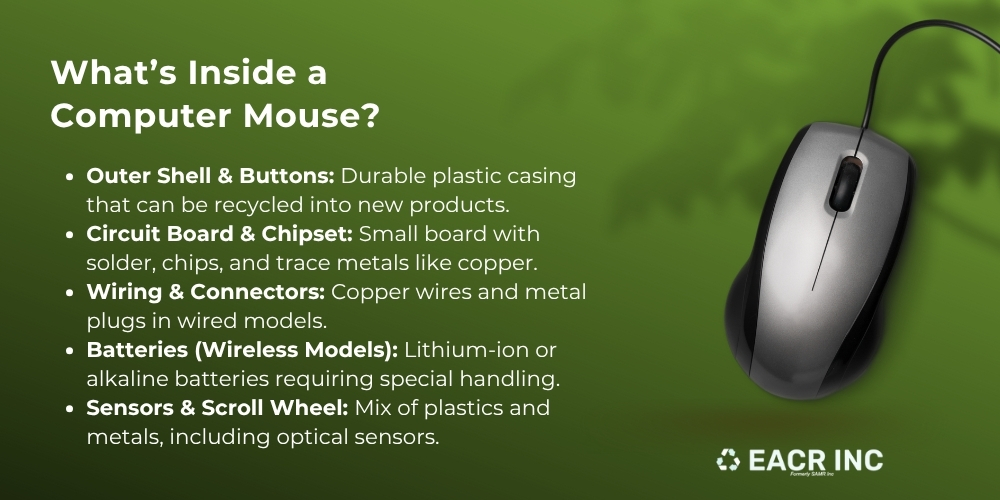
Outer Shell & Buttons
The casing and buttons are made of durable plastics. Once separated, these plastics can be recycled and repurposed for use in other products.
Circuit Board & Chipset
The small internal board contains solder, chips, and trace amounts of recoverable metals. While tiny, multiplied across millions of devices, this adds up to significant recoverable material.
Wiring & Connectors
Wired models often contain copper wiring and metal connectors. Copper, in particular, is highly reusable in manufacturing new electronics.
Batteries in Wireless Models
Wireless mice typically use lithium-ion or alkaline batteries. These must be removed and recycled separately, since batteries require special handling to avoid environmental damage.
Sensors & Scroll Wheels
The optical sensors, scroll wheels, and other small parts are a mix of plastics and metals. While minor individually, they can still be broken down and recycled properly.
The Risks of Tossing Old Mice in the Trash
E-Waste Growth
A computer mouse might not take up much space on its own, but millions of them end up in the waste stream every year. When combined with keyboards, cables, and other small peripherals, they contribute significantly to the global e-waste crisis.
Environmental Hazards
Inside every mouse are plastics, metals, and small circuit boards. Lead solder and plastic casings break down slowly in landfills, leaching toxins into the environment. Recycling keeps these harmful materials out of soil and water.
Missed Material Recovery
Copper wiring, reusable plastics, and small electronics inside mice are all recoverable resources. Tossing them away wastes materials that could be recycled and repurposed into new products.
How to Recycle a Computer Mouse
Local E-Waste Collection
Many towns and municipalities run e-waste collection events or maintain drop-off centers that accept small electronics, including mice. This is often the simplest option for households.
Retailer Take-Back Programs
Some office supply and electronics retailers accept used mice as part of their recycling initiatives. It’s worth checking if your local store has a drop-off box for small devices.
Partner with an Electronics Recycling Company
The most reliable method is working with an electronics recycling company like EACR Inc. They handle mice, keyboards, and full computer systems, ensuring materials are reclaimed properly and nothing ends up in a landfill.
Mail-In Programs
If you don’t have a local recycling option, mail-in programs are a convenient alternative. Many recyclers allow you to ship small electronics directly to their facility for processing.
Bulk Solutions for IT Departments
Businesses, schools, and government agencies often replace dozens or even hundreds of mice at once. Bulk pickup and e-waste container programs from companies like EACR Inc. make large-scale computer mouse recycling easy and compliant.
Alternatives to Recycling: Give Your Mouse a Second Life
Donation Opportunities
If your old mouse still works, consider donating it to a school, nonprofit, or library. These organizations often need extra computer equipment and can put it to good use.
Creative Reuse
Old mice don’t have to be junk. Key buttons, scroll wheels, or shells can be repurposed for DIY projects, crafts, or even used as teaching tools for kids learning how electronics work.
Repair & Refurbish
Some companies specialize in refurbishing old peripherals. A repaired mouse can be resold at a lower cost, extending its lifespan and reducing the demand for new manufacturing.
Why Choose EACR Inc. for Mouse Recycling
EACR Inc. is an experienced electronics recycling company with decades in the industry. We know how to handle small devices like mice as well as large-scale IT equipment, making the process smooth for both individuals and organizations.
- Decades of experience in electronics recycling across industries.
- Zero-landfill policy so every part is either recycled or disposed of safely.
- Bulk pickup and container options for businesses, schools, and government agencies.
- Certificates of Recycling provided for proof of recycling.
- Service areas include the entire NorthEast.
Looking to recycle more than just mice? EACR Inc. offers streamlined computer recycling services to handle everything from desktops and laptops to accessories like keyboards and monitors.
FAQs on Mouse Recycling
Yes. Mice are accepted with most other computer accessories such as keyboards, monitors, and cables. They can all be processed together as part of e-waste recycling programs.
They do. Wireless models often contain lithium-ion or alkaline batteries. These must be removed and recycled separately since batteries require specialized disposal.
Plastics, metals, and wiring are separated and processed. Reusable materials like copper and aluminum are recovered for manufacturing, while hazardous components are disposed of safely.
Absolutely. Companies like EACR Inc. provide bulk pickup and recycling container options designed for schools, offices, and IT departments that need to recycle dozens—or even hundreds—of mice at once.
Conclusion: Small Devices, Big Responsibility
Even though a mouse seems small, computer mouse recycling plays a big role in reducing e-waste. Recycling prevents plastics and metals from polluting landfills, allows materials like copper and aluminum to be recovered, and keeps organizations compliant with disposal laws.
Recycling mice may feel like a small step, but multiplied across millions of devices, the impact is huge.
Contact EACR Inc. for safe, secure, and convenient computer mouse recycling solutions today.