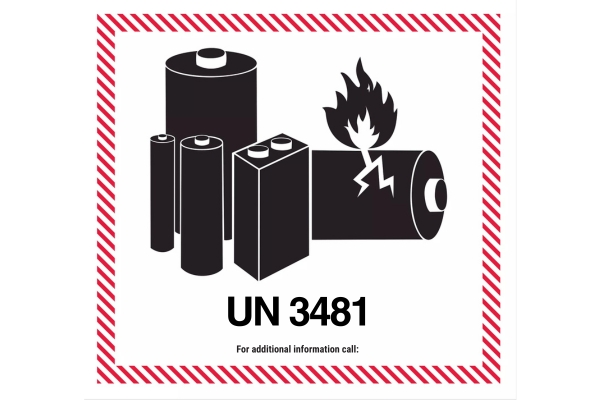
A UN3481 battery label identifies a package containing lithium-ion batteries that are either installed inside equipment or packaged in the same shipment as the equipment they power.
Common examples include laptops, mobile phones, tablets, power tools, medical equipment, cameras, and other rechargeable electronic devices.
The UN3481 marking alerts carriers and package handlers that the shipment contains regulated lithium-ion batteries and must be handled according to the applicable packaging, marking, documentation, and transportation requirements.
Explore EACR Inc.’s battery labels for markings designed to help businesses properly identify battery shipments.
What Does UN3481 Mean?
UN3481 is the United Nations identification number assigned to two lithium-ion battery shipping descriptions:
- Lithium-ion batteries contained in equipment
- Lithium-ion batteries packed with equipment
This classification also includes lithium-ion polymer batteries.
Under the U.S. Department of Transportation Hazardous Materials Regulations, both descriptions are listed as Class 9 hazardous materials. However, the exact marking, labeling, packaging, and documentation requirements depend on the battery specifications and how the shipment is prepared.
Batteries Contained in Equipment
“Contained in equipment” means the lithium-ion battery is installed inside the device it powers.
Examples include:
- A battery installed in a laptop
- A battery installed in a mobile phone
- A rechargeable battery built into medical equipment
- A battery installed in a cordless power tool
The equipment must be packaged to protect the battery from damage and prevent the device from turning on accidentally during transportation.
Batteries Packed With Equipment
“Packed with equipment” means the battery is not installed in the device, but it is shipped in the same package as the equipment it is intended to power.
For example, a camera shipped with a separate rechargeable battery may fall under UN3481 when the battery and camera are packaged together.
The battery must be protected against short circuits, separated from conductive materials, and secured against movement inside the package.
What Does the UN3481 Label Look Like?
The UN3481 identification number is commonly printed inside a lithium battery mark. The mark uses a rectangular design with diagonal hatching and a battery symbol showing one damaged battery emitting a flame.
The characters UN3481 appear near the bottom of the mark to identify the package’s contents.
Although it is commonly called a “UN3481 label,” regulations may distinguish between a mark and a hazard label. The UN3481 lithium battery mark identifies the battery type, while a fully regulated shipment may also require a separate Class 9 lithium battery hazard label.
Not every package containing a lithium-ion battery requires the same combination of marks and labels. Requirements depend on factors such as battery size, quantity, packaging configuration, transportation mode, and regulatory exception.
Are UN3481 Batteries Hazardous Materials?
Yes. Lithium-ion batteries shipped under UN3481 are classified as Class 9 hazardous materials or dangerous goods.
Lithium-ion batteries can release significant energy if they are damaged, crushed, improperly packaged, exposed to heat, or allowed to short circuit. A damaged battery may overheat and enter thermal runaway, potentially leading to smoke, fire, or the release of hazardous gases.
The equipment surrounding the battery may provide some protection, but it does not eliminate the need for proper packaging and shipment preparation. PHMSA and IATA both maintain specific transportation requirements for lithium batteries contained in or packed with equipment.
When is a UN3481 Battery Label Required?
A UN3481 mark may be required when a shipment contains qualifying lithium-ion batteries installed in equipment or packaged with the equipment they power.
Before applying the mark, the shipper should verify:
- Whether the batteries are installed in or packed with equipment
- The watt-hour rating of each battery
- The number of batteries and cells in the package
- The total battery weight
- Whether the batteries have passed UN 38.3 testing
- Whether the shipment is traveling by road, air, rail, or vessel
- Whether the batteries are new, used, damaged, defective, or recalled
- The requirements of the selected carrier and destination
Smaller batteries meeting specified conditions may qualify for regulatory exceptions, but they are not automatically exempt from all packaging or marking requirements. Fully regulated shipments may require additional hazard labels, shipping papers, dangerous-goods declarations, and trained personnel.
UN3481 Packaging Requirements
The exact packaging requirements vary, but a compliant UN3481 shipment generally must protect the batteries and equipment from movement, impacts, short circuits, and accidental activation.
Protect the Battery From Damage
Use strong packaging that can withstand normal handling during transportation. The battery and equipment should not move freely inside the package.
Prevent Short Circuits
Exposed battery terminals should be covered with nonconductive material or enclosed in packaging that prevents contact with metal, other batteries, or conductive surfaces.
Prevent Accidental Activation
Equipment containing batteries should be switched completely off and secured so buttons, switches, or controls cannot activate during transportation.
Use Strong Outer Packaging
When outer packaging is required, use a sturdy container appropriate for the weight, size, and contents of the shipment. Cushioning should protect the equipment and batteries from impacts.
PHMSA requires lithium batteries to be enclosed and protected using packaging appropriate to their shipping configuration, unless a specific regulatory provision permits another method.
Does Every UN3481 Shipment Need a Class 9 Label?
No. A package displaying UN3481 does not automatically require the same hazard labels and documentation as every other UN3481 shipment.
Fully regulated lithium-ion batteries generally require the Class 9 lithium battery hazard label. Smaller cells and batteries that satisfy an applicable exception may instead require the lithium battery mark displaying UN3481 without the full Class 9 labeling and documentation used for fully regulated shipments.
This distinction depends on the watt-hour rating, battery quantity, package configuration, transportation method, and regulations being used.
Shippers should never assume that purchasing a UN3481 label alone makes a shipment compliant.
What Information Should Be Checked Before Shipping?
Before preparing a UN3481 package, confirm the following information:
- Battery chemistry
- Watt-hour rating
- Battery dimensions and weight
- Number of cells and batteries
- Equipment type
- Battery configuration
- Battery condition
- UN 38.3 test status
- Transportation method
- Domestic or international destination
- Carrier-specific acceptance rules
Beginning January 1, 2026, IATA applies a state-of-charge limit of no more than 30% to lithium-ion batteries packed with equipment for air transportation. Shippers using air services should confirm the current IATA rules and any airline-specific restrictions before tendering a package.
Can a UN3481 Label Be Used for Damaged Batteries?
A standard UN3481 label should not be treated as sufficient authorization to ship a damaged, defective, swollen, leaking, or recalled battery.
These batteries face substantially stricter transportation restrictions because they present an increased fire risk. They may require special permits, specialized fire-resistant packaging, carrier approval, ground-only transportation, or another authorized shipping program.
A shipper should contact a qualified hazardous-materials professional, carrier, or battery recycling provider before attempting to transport a damaged lithium-ion battery.
Why Correct UN3481 Labeling Matters
Correct labeling helps carriers identify packages containing lithium-ion batteries and handle them under the appropriate transportation procedures.
Using the wrong identification number, missing a required mark, or applying a Class 9 label incorrectly can result in:
- Rejected shipments
- Transportation delays
- Additional carrier fees
- Regulatory penalties
- Increased fire and safety risks
The label is only one part of compliance. The battery must also be correctly classified, tested, packaged, documented, and accepted by the carrier.
Verify the Requirements Before Shipping
UN3481 identifies lithium-ion batteries contained in equipment or packed with the equipment they power. The required label or mark depends on the battery capacity, quantity, condition, package configuration, transportation mode, and destination.
Always review the latest U.S. Department of Transportation, IATA, and carrier requirements before applying a UN3481 label or offering a package for transportation.
For organizations preparing lithium-ion battery shipments, explore EACR Inc.’s battery labels to find clear markings for identifying regulated battery packages.