Here’s the quick truth: batteries don’t become sustainable because of a slogan on the box. “Eco,” “green,” “responsible”—none of that matters if the battery ends up crushed in a dumpster or mixed into the wrong load.
What you can control is the part that actually moves the needle: how batteries are used, stored, collected, and recycled. That’s where sustainability becomes real—because it reduces incidents, keeps materials in circulation, and creates a clean, defensible process (especially for businesses).
In this guide, we’ll break down what battery sustainability means by battery type, how to prevent the most common safety failures, and how organizations can run a program that holds up when someone asks, “Where did all those batteries go?”
What Battery Sustainability Actually Means
The 4-part definition
1) Use longer (don’t churn devices)
The greenest battery is usually the one you don’t replace early. Extending service life—through maintenance, proper charging habits, and smarter refresh cycles—cuts demand for new manufacturing and reduces how much waste you generate.
2) Prevent incidents (fires and leakage are sustainability failures)
A battery fire or leak isn’t just a safety problem—it’s a sustainability failure. Incidents destroy recoverable material, damage facilities, and push batteries into emergency disposal paths. Safe handling is part of doing this responsibly.
3) Recycle through the correct channel (not “mixed e-waste,” not scrap)
Batteries aren’t a one-bin category. Different chemistries have different risks and different downstream requirements. The sustainable move is routing each type through a battery-specific recycling channel, not dumping them into mixed electronics or scrap and hoping it sorts out later.
4) Track it (documentation is part of responsible management)
If you can’t prove what happened, you don’t really control the outcome. Tracking batteries by site, chemistry, quantity, and condition—plus keeping service records—turns recycling into a repeatable system instead of a one-off cleanup.
The Battery Lifecycle: Where Most Impact Really Happens
Mining and manufacturing are the heavy hitters
Most of a battery’s footprint happens before you ever touch it: mining raw materials, refining them, and manufacturing cells and packs. That’s why the best sustainability lever is simple: reduce replacement frequency and keep materials in circulation.
When you extend battery life and recycle correctly, you reduce demand for new extraction and you give recovered materials a chance to re-enter supply chains. That’s the real “sustainable” pathway—not a marketing label.
End-of-life is where risk spikes
End-of-life is the moment where small mistakes become big problems:
- Landfill = long-term contamination risk. Batteries corrode over time. Even “small” batteries add up when thousands get tossed.
- Waste stream = crushing/shorting risk → incidents. Trash trucks, compactors, and transfer stations crush batteries. That’s how fires start.
- Recycling = controlled routing + material recovery pathways. Proper recycling keeps batteries out of uncontrolled environments and routes materials into recovery streams designed for their chemistry and condition.
This is the stage you can control the most—so it’s where sustainability programs should focus.
The Sustainability Breakdown by Battery Type
(This is where battery sustainability stops being vague and becomes operational.)
Lead-acid (mature recycling channel, still needs control)
Lead-acid batteries have a more established recycling pathway than most other battery types, which makes them “easier” operationally—if you handle them correctly. Collection systems are common, and the downstream process is well-developed.
Where it still fails is usually boring stuff that causes real damage:
- Batteries stored tilted or stacked poorly → leaks
- Heavy units staged without stability → tipping
- No secondary containment → mess spreads fast
- “We’ll grab them later” stockpiles → risk grows over time
Sustainability takeaway: lead-acid has a strong recovery channel, but only if you stage safely, prevent leaks, and move them consistently instead of letting them become a storage problem.
Lithium-ion + lithium polymer (highest incident risk when mishandled)
For lithium batteries, sustainability and safety are basically the same conversation. The biggest sustainability failure here isn’t “wasting materials”—it’s creating a fire.
Lithium-ion and lithium polymer packs can escalate quickly when:
- terminals are bridged (short circuit)
- packs are crushed or punctured
- damaged units are mixed in with intact loads
- batteries are stored loose in metal containers or with scrap
Sustainability takeaway: prevent shorts, isolate damaged units, don’t crush, don’t stockpile. A clean lithium program is one that stays controlled from the moment batteries come out of devices until they’re removed.
Lithium primary cells (including Li-SOCl₂) are a different conversation
Lithium primary cells—like lithium thionyl chloride (Li-SOCl₂)—are built for long life and low drain. You’ll see them in meters, sensors, alarms, instrumentation, and remote monitoring devices.
The sustainability miss happens because these batteries look “small and harmless,” so people treat them casually:
- mixed into general battery buckets without checking acceptance
- stored loose, rattling around
- tossed into scrap loads where they can short or get crushed
Sustainability takeaway: lithium primary needs chemistry-specific routing. At scale—especially across multiple sites—controlled pickup and standardized staging is usually the cleanest way to keep it safe and consistent.
NiCad vs NiMH (a sustainability story about toxic metals vs controlled recovery)
These two get lumped together because they look similar, but sustainability-wise they’re not the same.
- NiCad: cadmium risk means tighter handling expectations. It’s regulated for a reason—cadmium is persistent and toxic.
- NiMH: less toxic than NiCad, but still regulated rechargeable waste that shouldn’t be trashed or mixed casually.
In both cases, the biggest operational mistake is mixing chemistries. Mixed loads increase risk, slow processing, and can turn a manageable stream into a problem.
Sustainability takeaway: sorting matters. Mixing chemistries ruins both safety and recovery outcomes—and it’s one of the easiest mistakes to prevent.
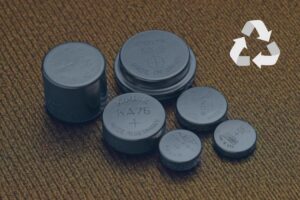
Button cells (small size, outsized safety issues)
Button cells are tiny, which makes them easy to ignore—and that’s exactly why they’re risky. Two big issues show up constantly:
- Shorting risk (loose cells touching metal items like keys, coins, screws)
- Ingestion hazard (serious risk for kids and pets)
Because they’re small, they also disappear into junk drawers and “random battery bins” where they get mixed and mishandled.
Sustainability takeaway: secure storage, non-metal containers, and quick routing. For button cells, “sustainability” starts with not letting them become a loose, unmanaged pile.
The “Recycling Gap” Isn’t Just Infrastructure: It’s Process
Why batteries don’t get recycled properly in the real world
Most battery recycling failures aren’t because people want to do the wrong thing. It’s because the process is unclear and nobody owns it.
- Confusion: mixed chemistries, unclear rules, and the classic “we’ll deal with it later.”
- Operational friction: no containers, no pickup plan, no clear point person—so batteries drift into drawers, closets, and random bins.
Battery recycling works when it’s a repeatable system. When it’s ad-hoc, it turns into a safety and compliance problem fast.
The three failure points that cause most problems
1) Collection: loose batteries + mixed bins
This is where shorts start. Loose cells rolling around with metal debris and other chemistries is the most common “silent” risk.
2) Staging: no terminal protection, damaged units mixed in
Intact + damaged batteries should never be treated the same. A swollen, dented, or leaking unit doesn’t belong in a general pile.
3) Transport: last-minute decisions, wrong packaging, wrong channel
When routing is decided at the last second, mistakes happen: wrong carrier rules, wrong packaging, wrong program acceptance—and that’s how projects stall or loads get rejected.
A Practical Battery Sustainability Playbook
Step 1: Identify + sort
Label-based sorting rules
- Sort by chemistry first (lead-acid, lithium-ion/LiPo, lithium primary, NiMH, NiCad, button cells).
- When possible, sort by format too (loose cells vs packs vs cartridges/modules).
Default behavior for unknowns
If you can’t confirm chemistry quickly, default to:
- Treat as “unknown lithium” until confirmed
- Keep it separate, protect terminals, and don’t mix it into a general battery bin.
This one rule prevents most of the high-consequence mistakes.
Step 2: Stage safely
- Protect terminals (especially anything loose or with exposed contacts)
- Use non-metal containers for loose cells (no coffee cans, no scrap bins)
- Keep loads dry, cool, stable, and out of traffic
- Separate intact vs damaged/suspect immediately
- If it’s swollen, dented, corroded, leaking, or “just feels wrong,” isolate and label it
- If it’s swollen, dented, corroded, leaking, or “just feels wrong,” isolate and label it
Safe staging is sustainability. Fires and leaks erase whatever “green” benefit people think they’re getting.
Step 3: Choose the right route (small vs business)
Mail-back / return label
Best for small volumes and consistent, eligible formats—when the program explicitly accepts what you have and you can follow packaging rules.
Drop-off
Fine for small batches if acceptance is confirmed (chemistry + condition). Good for consumers and small cleanouts. Less consistent for business documentation.
Scheduled pickup
Best for volume, multi-site, damaged units, and deadlines. It standardizes handling, reduces on-site stockpiles, and usually produces the cleanest documentation trail.
Step 4: Document it
What to log (minimum)
- Site/location
- Date
- Chemistry (and format when possible)
- Quantity or weight
- Condition notes (intact vs damaged/suspect)
What to keep
- Pickup/service record
- Certificates of recycling
Why it matters
This isn’t “paperwork for fun.” It supports:
- Audits and compliance files
- ESG reporting and internal sustainability metrics
- Vendor management
- Incident defense (when someone asks what happened and when)
“Second Life” and Reuse: When It’s Real and When It’s Marketing
What reuse looks like in practice
Reuse is real when it’s tested, appropriate, and safe—meaning someone verifies performance and condition, and there’s a defined use case.
It’s not real when it’s just:
- “We’re saving them for later”
- Batteries stored indefinitely with no testing, no plan, and no routing date
If it turns into a stockpile, it’s not reuse—it’s delayed risk.
The best sustainability move is often boring
The highest-impact battery sustainability moves usually aren’t flashy:
- Maintain batteries properly
- Replace before failure in critical systems (UPS, medical, security, infrastructure)
- Avoid stockpiles
- Route promptly through a controlled program
Boring is good. Boring is stable. Stability is sustainable.
Common Myths That Make Battery Sustainability Worse
- “They’re dead, so they can’t cause a problem.”
Dead batteries can still short, leak, and start incidents when crushed or mishandled. - “All batteries can go in the same bucket.”
Mixing chemistries increases risk and usually reduces processing quality. - “If it’s small, it’s safe.”
Small batteries are easier to lose, easier to mix, and easier to short—especially button cells and lithium primaries. - “Recycling = throwing it in any e-waste bin.”
Batteries need battery-specific routing. General e-waste and scrap aren’t the right channels. - “We’ll document it later.” (No one does.)
If you don’t log it when it moves, it won’t be logged—and that’s how programs fail.
Conclusion: Battery Sustainability is a Process You Can Run
Battery sustainability is simple when you treat it like a system: extend life, prevent incidents, recycle by chemistry, and document it. That’s how you reduce risk, protect operations, and keep your outcomes defensible.
If you’re managing volume, multi-site batteries, UPS replacements, meters/sensors, or mixed-condition loads, EACR Inc. can set up a repeatable battery recycling program with staging guidance, pickup logistics, and documentation that stays tight.